 OGP Product Report Cards
ScamShield

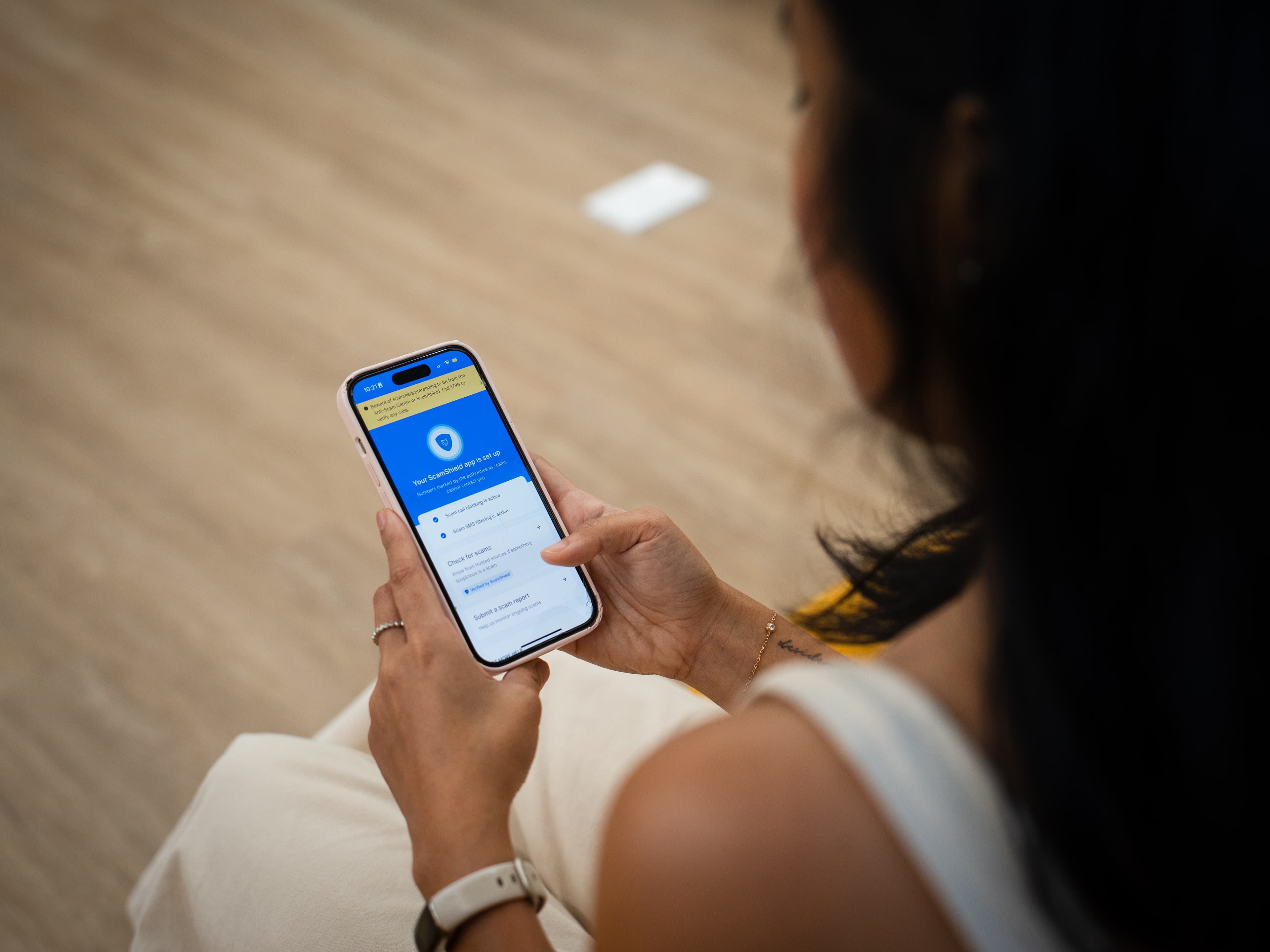
The ScamShield mobile app lets people check suspicious calls and messages, and report scams to the authorities.
The problem
Judging whether a call or message is a scam takes time and information. Scammers exploit that: they change tactics faster than warnings spread and rush people into acting. Some lose money.
Our solution
We block or alert users to scam calls and messages as they arrive on their phones. Each user's report exposes a new tactic, and ScamShield updates its detection to protect other users.
Quarterly updates
Q3 Metrics
Scam Protectionvs previous quarter
Total Scam Alerts4.39Mup 7%
User Reachvs previous quarter
Monthly Defended Users (excl. iOS Passive)196,359up 14%
Monthly Reporting Users42,471up 16%
Protection Coveragevs previous quarter
Precision86%down 6 pts
Recall85.8%down 1.1 pts
User Satisfactionvs previous quarter
Weighted Average CSAT4.73 / 5up 0.01
Cost Effectivenessvs previous quarter
Cost per scam alert$0.17No change
Q3 Costsvs previous quarter
People$299.5k41%down 8%
Overheads$240.6k33%up 6%
Infrastructure$96.6k13%up 4%
Tools$52.3k7%up 94%
Security$24.9k3%
Other$10.4k1%down 13%
Total for quarterSum of all costs$724.2kup 6%
Released in Q3
- Completed measurement for automatically blacklisting scam SMS senders (Q2 launch): After clearing a backlog of 5.4K numbers, the system blocks about ~600 additional numbers each month that did not have enough reports for ops review, increasing blacklisted senders by 18.7%. Another 45 numbers each month were blacklisted within about 15 minutes rather than waiting for manual review.
- Completed and rolled back the Scam Trend Alerts experiment (Q2 launch): Ran eight weekly alerts and surveyed 1,006 users. Among survey respondents, of users who read an alert, 97% found it useful. However, reach was limited: 13.3% opted in and each alert had a ~16**% average open rate**—roughly 2 readers for every 100 eligible users. We could not establish that alerts increased checks, reports, or on-device protection. The feature was removed on 7 September so the team could focus on measurable on-device protection; it may be revisited when experiment tooling can measure behaviour change.
- Tested web-based scam reporting with SPEO and GovTech: Ran a four-week web reporting pilot on on scamshield.gov.sg for people who prefer a desktop or do not want to install the app. From 2–16 September, it generated about 2.2% of average in-app call report volume. We are scoping a direct pipeline into the ScamShield dashboard, so we can use the reports to protect users.
- Launched background blacklist updates for iOS: For iOS, launched background updating so call-blocking blacklist can update without requiring users to reopen the app. This addresses a gap where 41% of eligible iOS devices had no detected return after registration and returning devices took a median of 26 days. iOS still schedules background work opportunistically, so updates cannot be guaranteed for users who force-quit the app, disable Background App Refresh, or have the app offloaded.
- Supported disruption of the courier scam variant: Provided SPF with user-submitted screenshots and trend analysis, and amplified warnings through push notifications, in-app modal and web banner. ScamShield reports contributed to the disruption of 30,900 email accounts (99.4% of all emails disrupted for the variant) and 3,600 phishing URLs (80% of all URLs disrupted).
- Completed security testing: Completed VAPT and closed all major-to-medium findings.
Who’s working on it
10 contributors in Q3
 Product manager100% time
 Product manager100% time
 Designer80% time
 Engineer50% time
 Engineer18% time
 Engineer100% time
 Engineer100% time
 Operations100% time
 Operations100% time
 Operations100% time
Info
- Status
- In active development
- Primary users
- Citizens
- Live since
- 2020
- Website
- scamshield.gov.sg


